Client project · Freight spend & vendor cost analysis · 12 months of invoice history
Freight Cost & Invoice Review
Standardized twelve months of messy freight invoices, normalized currencies, built unit economics, and produced a review queue that says what to check and why.
Advanced Excel
- Scope
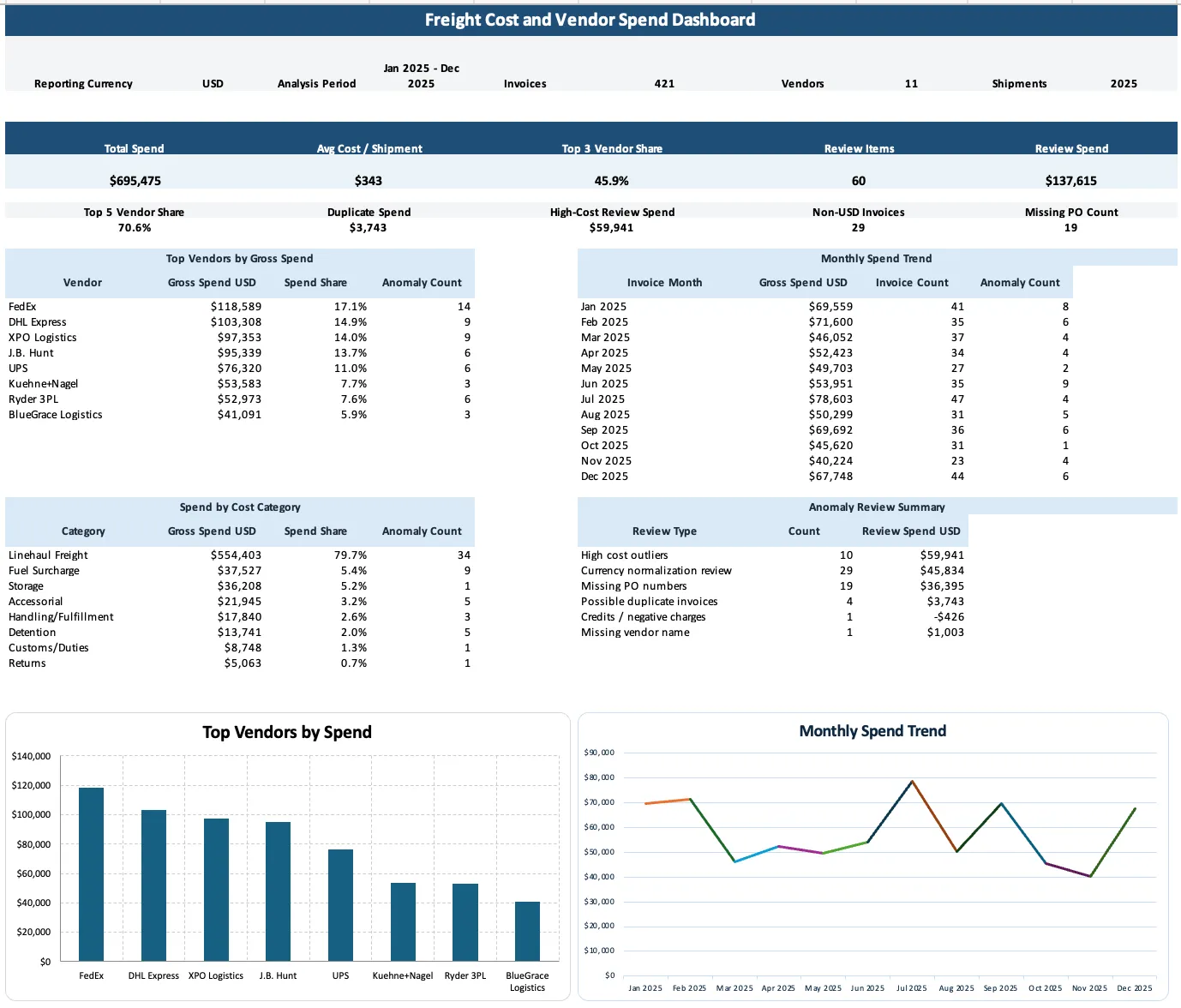
- 421 lines 11 vendors, $695,475 of reviewed spend over 12 months
- Method
- 4 anomaly flags duplicate, missing PO, currency review and high cost
- Finding
- 60 lines flagged for review, worth $137,615
Challenge
Twelve months of freight invoices arrived as a raw extract. The same carrier appeared as FEDEX, FEDEX GROUND, Fedex and FEDERAL EXPRESS. Cost types were free text, several invoices were in non-USD currencies, nineteen had no PO number, and one had no vendor name at all. Nothing could be grouped or compared until that was fixed.
What I did
- Standardized vendor names through a lookup resolving every raw spelling to one vendor and vendor group. Dozens of variants collapsed to 11 vendors; the unidentifiable invoice was left as
Needs Reviewrather than quietly dropped. - Normalized cost categories from free-text invoice types, and converted everything to USD so the largest invoices were not simply the ones in the strongest currency. 29 non-USD invoices were flagged as normalized so the conversion stays visible.
- Built unit economics — cost per shipment, per kilogram and per mile — so carriers running different modes could be compared on something other than gross spend.
- Applied four anomaly flags across every line: possible duplicate, missing PO, currency review and high cost. Each flagged line carries a written comment and a recommended action, over raw data kept intact as an audit trail.
Decision
Flagged spend is spend that needs review, not savings. The $137,615 flagged here is recoverable only where validation against AP records and vendor statements says it is.
Key findings
- 60 invoice lines worth $137,615 for review, including $3,743 of possible duplicates across four lines — one an exact pair matching on vendor, invoice number, shipment ID and amount.
- 19 invoices with no PO number, worth $36,395. That is a procurement control gap rather than a pricing problem, and it is fixed in a different place.
- Concentration worth knowing about: the top three vendors hold 45.9% of spend, and linehaul is 79.7% of it — so accessorial and fuel optimization has a much smaller ceiling than it first appears.
Limitations
- Flags are directional. Each one needs validating against source invoices and AP records before any financial action.
- Duplicate detection matches on invoice, vendor, shipment and amount. Genuine re-bills and split shipments can look identical to a duplicate.
- FX comes from a fixed rate table rather than each invoice’s transaction date.
-
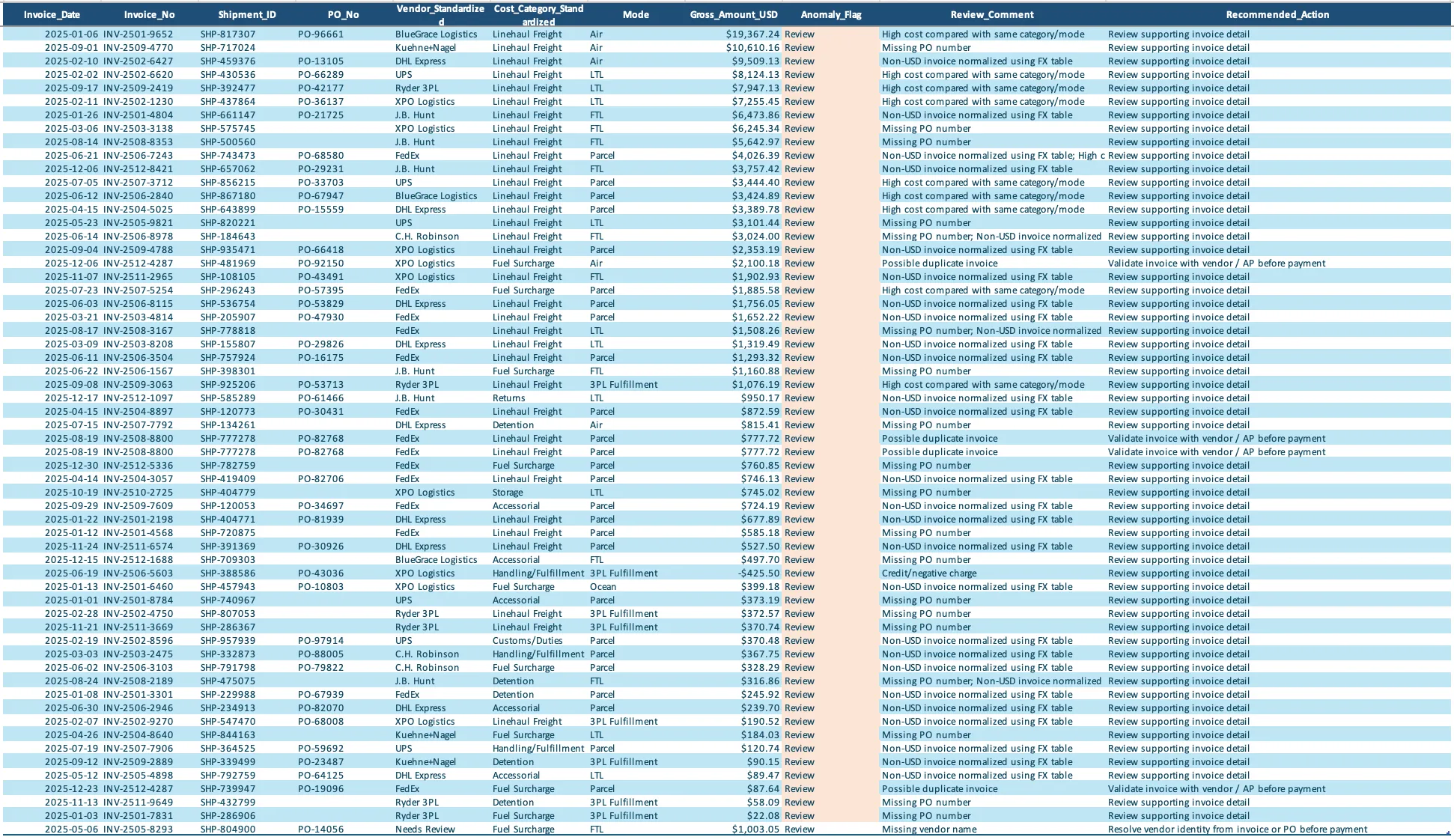
Anomaly_Review — Every flagged line carries a reason and a recommended action. -
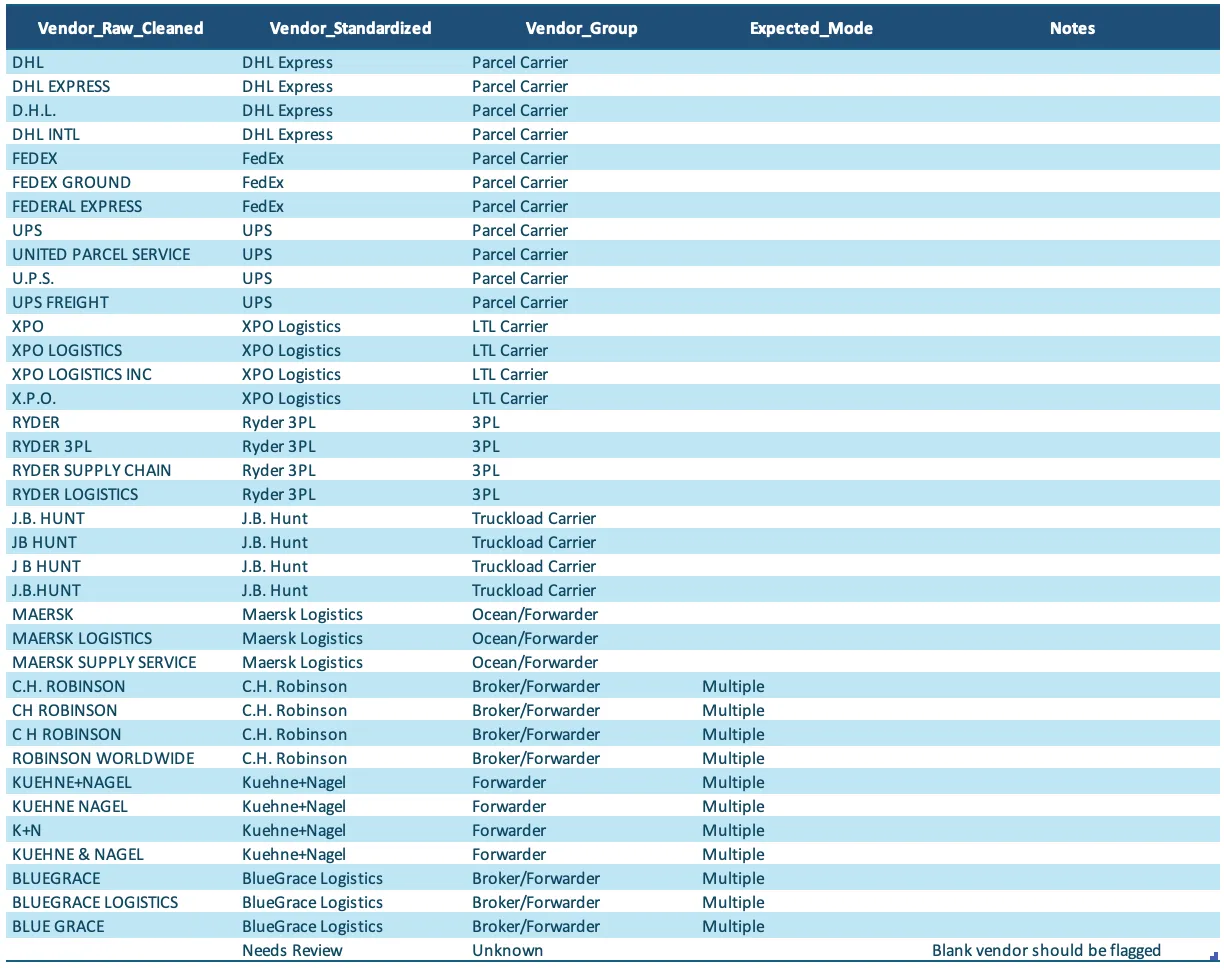
Vendor_Mapping — Eleven vendors were hiding behind dozens of raw spellings.
Client identity is withheld. Data, screenshots and supporting artifacts are sanitized for portfolio use.